Digital banking security is entering a new era. With the rapid development of quantum computing, traditional encryption methods that protect your bank accounts, payments, and personal data may eventually become vulnerable.
This is where post-quantum cryptography in digital banking comes in.
In this beginner-friendly guide, you’ll learn:
✔ What post-quantum cryptography (PQC) is
✔ Why banks are adopting quantum-resistant encryption
✔ How it affects your online banking security
✔ What changes customers and fintech platforms should expect by 2026 and beyond
If you use mobile banking, digital wallets, or fintech apps, this topic will directly impact your financial safety.
What Is Post-Quantum Cryptography?
Post-quantum cryptography (PQC) refers to encryption algorithms designed to remain secure even against powerful quantum computers.
Today’s digital banking relies on:
- RSA encryption
- Elliptic curve cryptography (ECC)
- Public key infrastructure (PKI)
Quantum computers could break these using Shor’s algorithm, which can factor large numbers exponentially faster than classical computers.
PQC replaces vulnerable systems with quantum-resistant algorithms.
Why Digital Banking Needs Quantum-Resistant Encryption
Banks handle:
✔ Payment transactions
✔ Identity verification
✔ Account authentication
✔ Interbank transfers
If quantum computers decrypt stored financial data, attackers could access:
- Encrypted transactions
- Personal financial records
- Digital signatures
This is called “harvest now, decrypt later”—a major reason banks are transitioning early.
Key PQC Algorithms Used in Banking
Post-quantum cryptography includes:
Lattice-Based Cryptography
Most widely adopted for:
- Secure key exchange
- Digital signatures
Hash-Based Signatures
Used for:
- Transaction verification
- Long-term security
Code-Based Cryptography
Strong for:
- Encrypted communication
- Data protection
These are being standardized for financial systems.
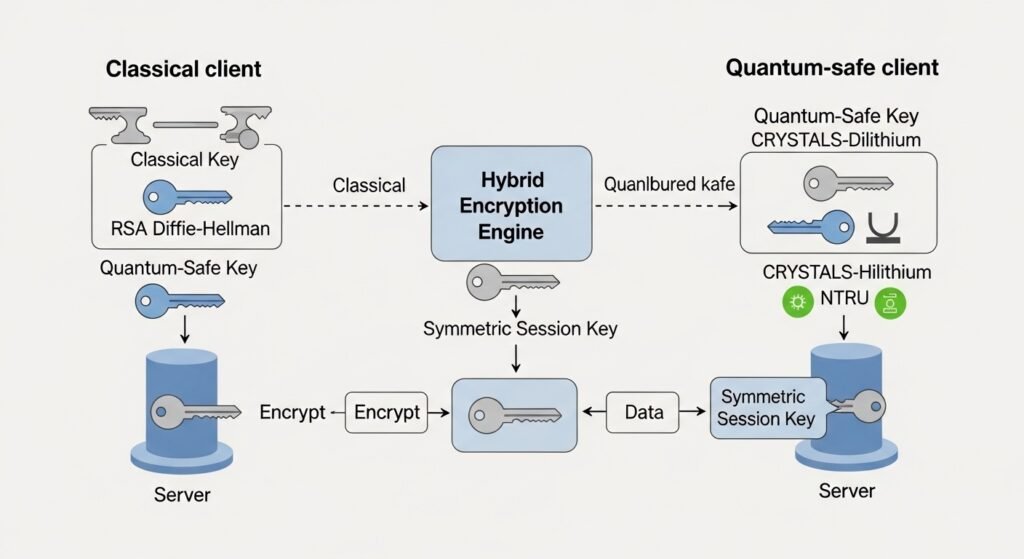
How PQC Works in Digital Banking
In a quantum-secure banking system:
- You log into your banking app
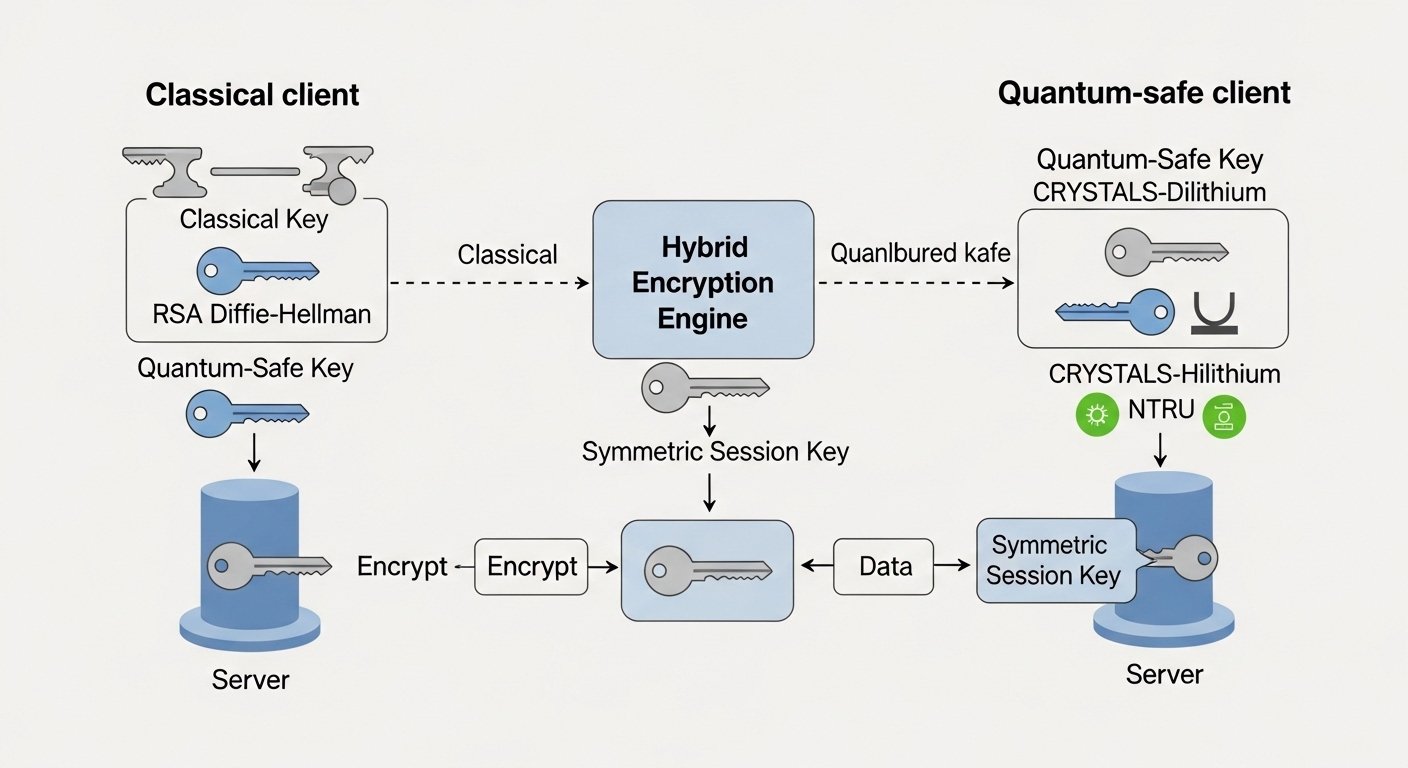
- Your device performs a PQC key exchange
- The bank verifies your identity using quantum-safe signatures
- Your session is encrypted using hybrid cryptography
Hybrid systems combine:
✔ Classical encryption
✔ Post-quantum algorithms
This ensures compatibility during the transition.
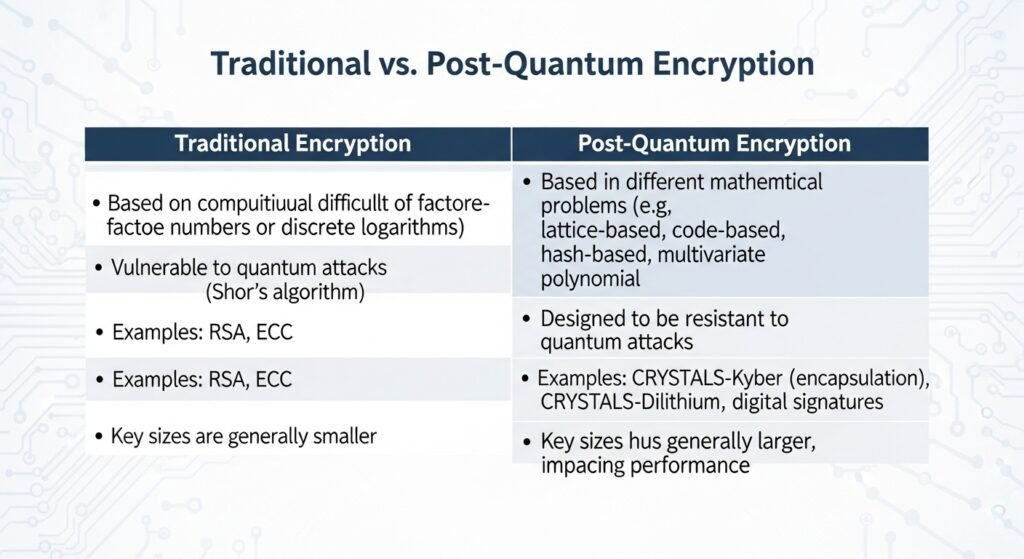
Post-Quantum Cryptography vs Traditional Encryption
| Feature | Traditional Encryption | Post-Quantum Cryptography |
|---|---|---|
| Quantum resistance | No | Yes |
| Used today | Yes | Emerging |
| Key size | Smaller | Larger |
| Speed | Faster | Slightly slower |
| Future security | At risk | Long-term safe |
| Bank adoption | Current standard | Migration phase |
PQC is future-proof, not necessarily faster.
Timeline: When Will Banks Fully Adopt PQC?
2024–2026
Hybrid encryption rollout in digital banking apps
2026–2028
Quantum-safe authentication for payments and APIs
2028+
Full migration to PQC infrastructure
Customers won’t see major interface changes, but security layers will improve.
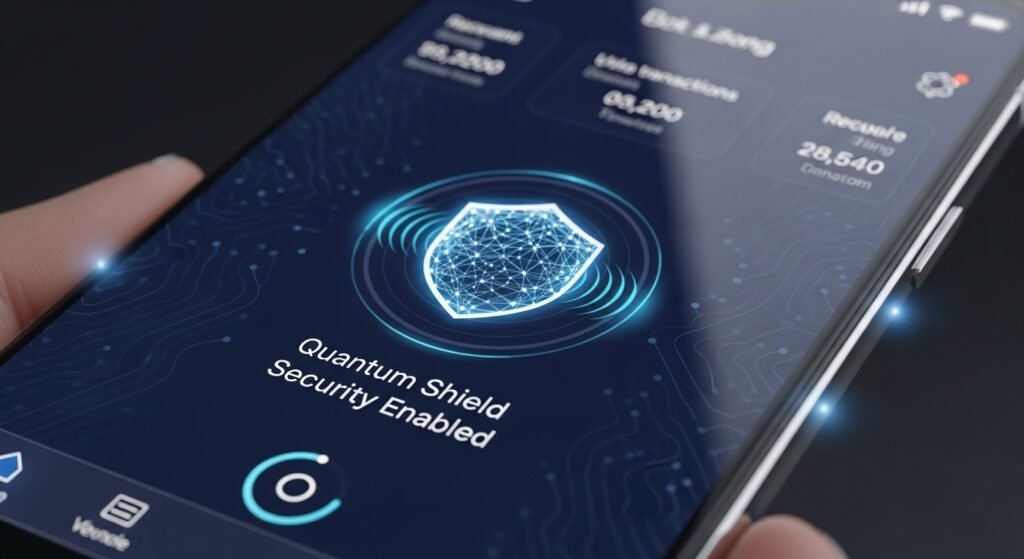
How PQC Protects Everyday Banking Activities
Post-quantum cryptography secures:
✔ Mobile banking logins
✔ Online payments
✔ Digital wallets
✔ Cross-border transfers
✔ Open banking APIs
It also protects long-term stored financial data.
Why Fintech and Neobanks Are Leading PQC Adoption
Fintech platforms adopt faster because they:
- Use cloud infrastructure
- Update APIs quickly
- Implement zero-trust security models
Traditional banks are migrating through hybrid cryptographic systems.
Practical Benefits for Customers
You don’t need to understand quantum physics to benefit.
PQC provides:
✔ Stronger identity protection
✔ Safer mobile transactions
✔ Future-proof encrypted records
✔ Reduced fraud risk
Your banking experience stays the same—but more secure.
Challenges of Post-Quantum Cryptography
Larger Key Sizes
PQC requires more storage and bandwidth.
System Migration Costs
Banks must upgrade:
- Servers
- ATMs
- Payment networks
Performance Optimization
Developers are optimizing PQC for mobile devices.
What Businesses and Developers Should Do Now
If you run fintech products:
✔ Audit current cryptography
✔ Implement hybrid PQC systems
✔ Update TLS protocols
✔ Monitor NIST PQC standards
Early adoption prevents future breaches.
FAQs
What is post-quantum cryptography in banking?
It is quantum-resistant encryption used to protect financial data from future quantum computer attacks.
Will quantum computers break current banking encryption?
Not yet, but they could in the future, which is why banks are transitioning now.
Do customers need to do anything?
No. Banks will implement PQC automatically in their systems.
Is post-quantum cryptography already in use?
Yes, many banks are deploying hybrid cryptographic systems.
Does PQC make banking slower?
Slightly in early stages, but optimizations are improving performance.
Post-Quantum Cryptography and Digital Payments
PQC will secure:
- Contactless payments
- CBDCs (central bank digital currencies)
- Real-time payment systems
This ensures long-term financial data protection.
The Future of Quantum-Safe Banking
By 2030, quantum-safe encryption will be the global standard.
Expect:
✔ Quantum-secure digital identities
✔ PQC-protected blockchain systems
✔ AI-driven fraud detection with quantum security
Digital banking will be safer than ever.
Final Thoughts: Why PQC Matters for Your Financial Security
Post-quantum cryptography is not just a technical upgrade—it’s a necessary evolution in digital banking security.
It protects:
✔ Your savings
✔ Your transactions
✔ Your financial identity
✨ About Artisan Anthology
At Artisan Anthology, we curate timeless digital creations designed to inspire and elevate every part of your lifestyle. Our collection includes brand books, digital templates, recipes, ebooks, wardrobe planners, fashion guides, printable wall art, and elegant home décor designs. We also specialize in wedding cards, invitations, baby shower cards, and engagement cards, each crafted to celebrate life’s most meaningful moments.
For professionals and dreamers alike, our CV templates, guided journals, and manifestation planners are created with intention to help you tell your story beautifully and authentically.
✨ Discover our full collection of digital products here → ArtisanAnthology.xyz