

Do you wake up feeling foggy, distracted, or immediately overwhelmed by notifications?
If you’re searching for science-backed morning routines for clarity, you’re not alone. Neuroscience, psychology, and behavioral science consistently show that the first 60–90 minutes of your day significantly influence focus, emotional regulation, and productivity.
This elite 2026 guide explains:
✔ The best morning routine for mental clarity based on research
✔ Brain-boosting habits backed by neuroscience
✔ Morning rituals to reduce anxiety and brain fog
✔ A step-by-step clarity routine you can implement tomorrow
✔ A comparison of common morning habits (what works vs what doesn’t)
If you want sharper thinking, calmer energy, and sustained focus — this guide is designed to help you build a clarity-focused morning routine that actually works.

Why Morning Routines Matter for Mental Clarity
Your brain transitions through multiple states after waking:
- Sleep inertia
- Cortisol awakening response
- Dopamine regulation
- Circadian rhythm activation
What you do during this window affects:
✔ Cognitive performance
✔ Decision-making
✔ Emotional resilience
✔ Stress levels
✔ Attention span
A structured, evidence-based routine reduces chaos and improves clarity.
The Neuroscience of Morning Clarity
1. Cortisol Awakening Response (CAR)
Within 30–45 minutes of waking, cortisol naturally increases to promote alertness.
Helpful for:
✔ Energy
✔ Focus
✔ Motivation
But excessive stimulation (like doomscrolling) can spike stress.
2. Dopamine and Motivation
Small wins early in the day regulate dopamine pathways.
This enhances:
✔ Motivation
✔ Task initiation
✔ Follow-through
3. Decision Fatigue Prevention
Morning structure reduces cognitive load, preserving mental energy for meaningful work.
The Ultimate Science-Backed Morning Routine for Clarity
Below is a step-by-step routine grounded in research.
Step 1: Wake Without Immediate Phone Use (0–10 Minutes)
Why it works:
✔ Reduces stress spikes
✔ Prevents reactive thinking
✔ Protects attention
Instead:
- Take 5 deep breaths
- Sit upright
- Stretch gently
Step 2: Hydrate Immediately (5–15 Minutes)
After 7–8 hours without fluids, dehydration contributes to brain fog.
Drink:
✔ 1 glass of water
✔ Optional pinch of salt or lemon
Hydration improves:
- Cognitive function
- Reaction time
- Mood stability
Step 3: Morning Light Exposure (10–20 Minutes)
Natural light regulates circadian rhythm.
Benefits:
✔ Improves alertness
✔ Supports sleep quality later
✔ Reduces brain fog
If possible:
- Step outside
- Open windows
- Avoid sunglasses briefly
Step 4: Movement Activation (15–30 Minutes)
Exercise increases:
✔ Blood flow to the brain
✔ BDNF (brain-derived neurotrophic factor)
✔ Dopamine and serotonin
Options:
- 10-minute walk
- Light yoga
- Mobility drills
- Short strength session
You don’t need intense workouts — consistency matters more.
Step 5: Mindfulness or Journaling (5–15 Minutes)
Research shows mindfulness:
✔ Reduces anxiety
✔ Improves attention
✔ Enhances emotional regulation
Simple methods:
- Box breathing
- Gratitude journaling
- Intention setting
Step 6: Single Priority Planning (5 Minutes)
Write down:
✔ One key task for the day
✔ Two secondary tasks
This prevents overwhelm.
Clarity comes from focus — not long to-do lists.
Step 7: Protein-Focused Breakfast (Optional but Beneficial)
Protein stabilizes blood sugar and reduces mid-morning crashes.
Examples:
✔ Eggs
✔ Greek yogurt
✔ Nuts
✔ Smoothies with protein
Avoid high-sugar breakfasts that spike insulin.

Comparison Table: High-Clarity vs Low-Clarity Mornings
| Habit | High-Clarity Routine | Low-Clarity Routine |
|---|---|---|
| Phone Use | Delayed | Immediate |
| Hydration | Immediate | Coffee first |
| Light Exposure | Natural sunlight | Artificial indoor light |
| Movement | Light exercise | Sedentary |
| Planning | Single priority | No plan |
| Breakfast | Balanced protein | High sugar |
Small differences compound daily.
Morning Habits That Reduce Mental Clarity
Avoid:
❌ Checking social media immediately
❌ Reading stressful news
❌ Skipping hydration
❌ Drinking coffee before water
❌ Oversleeping repeatedly
❌ Chaotic multi-tasking
How Long Should a Morning Clarity Routine Be?
Ideal range:
✔ 30–60 minutes
But even 20 minutes of structured activity improves mental sharpness.
Consistency > Duration.
Practical Tips to Make It Sustainable
1. Prepare the Night Before
✔ Place journal on desk
✔ Fill water bottle
✔ Set workout clothes out
2. Use Habit Stacking
Pair habits:
- Hydrate → stretch
- Sunlight → walk
- Coffee → journaling
3. Start Small
Implement:
✔ 3 habits first
Then expand.
Morning Routine for Different Lifestyles
Busy Professionals
✔ 5 min breathwork
✔ 10 min walk
✔ 5 min planning
Students
✔ Light exposure
✔ 10 min movement
✔ Review top academic task
Entrepreneurs
✔ Deep work priority planning
✔ Mindfulness
✔ Strategic journaling
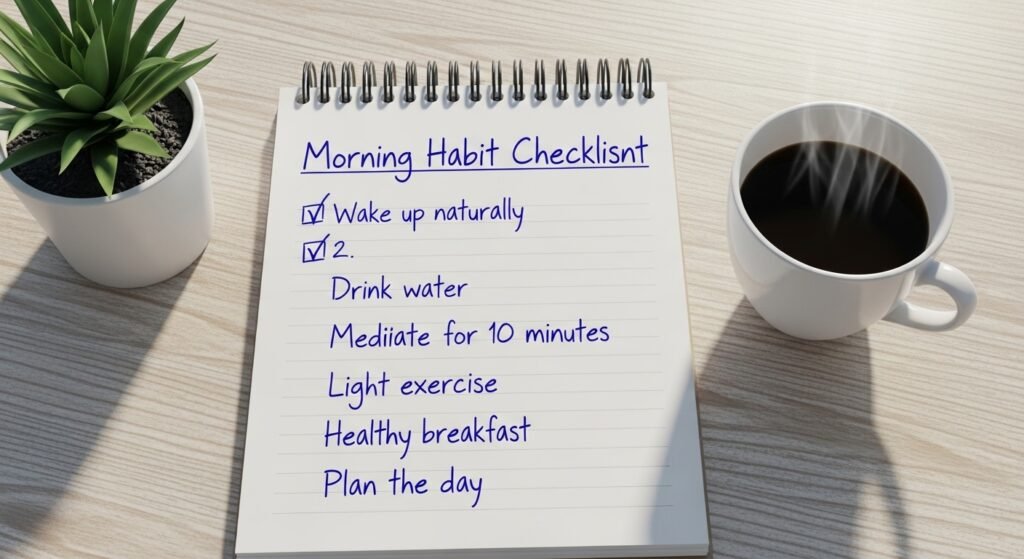
Advanced Strategies for Maximum Clarity
1. Cold Exposure (Optional)
Brief cold showers may:
✔ Increase alertness
✔ Boost dopamine
Use cautiously.
2. Caffeine Timing
Wait 60–90 minutes after waking to consume caffeine.
This aligns better with cortisol rhythms.
3. Digital Minimalism
Delay email and Slack for first hour.
Protect deep focus window.

Frequently Asked Questions
What is the best science-backed morning routine for clarity?
A routine that includes hydration, light exposure, movement, mindfulness, and single-task planning is most effective for improving focus and mental clarity.
How long does it take for a morning routine to improve mental clarity?
Most people notice improvements within 1–2 weeks of consistent practice.
Does morning sunlight really improve brain function?
Yes. Natural light regulates circadian rhythm, enhances alertness, and supports long-term cognitive health.
Should I avoid my phone in the morning?
Yes. Avoiding immediate phone use reduces stress spikes and improves attention control.
Is coffee bad for morning clarity?
Not necessarily. But delaying caffeine for 60–90 minutes may improve natural energy regulation.
The 30-Day Clarity Challenge
Week 1:
✔ Hydrate + no phone
Week 2:
✔ Add movement
Week 3:
✔ Add journaling
Week 4:
✔ Add single-task planning
Gradual integration builds sustainable habits.
Long-Term Benefits of a Clarity-Focused Morning
✔ Reduced anxiety
✔ Improved focus
✔ Higher productivity
✔ Better emotional regulation
✔ Enhanced creativity
Morning discipline creates cognitive advantage.
Action Plan: Build Your Science-Backed Morning Routine
Tomorrow morning:
- Don’t check your phone
- Drink water
- Get 10 minutes of sunlight
- Move your body
- Write one priority
Simple. Practical. Powerful.

Final Thoughts: Clarity Is Built, Not Found
Mental clarity isn’t accidental — it’s structured.
A science-backed morning routine:
✔ Aligns with your brain’s natural rhythms
✔ Reduces stress
✔ Enhances attention
✔ Improves productivity
You don’t need a 2-hour ritual.
You need intentional first steps.
Start tomorrow.
Protect your mornings.
Your clarity will follow.
✨ About Artisan Anthology
At Artisan Anthology, we curate timeless digital creations designed to inspire and elevate every part of your lifestyle. Our collection includes brand books, digital templates, recipes, ebooks, wardrobe planners, fashion guides, printable wall art, and elegant home décor designs. We also specialize in wedding cards, invitations, baby shower cards, and engagement cards, each crafted to celebrate life’s most meaningful moments.
For professionals and dreamers alike, our CV templates, guided journals, and manifestation planners are created with intention to help you tell your story beautifully and authentically.
✨ Discover our full collection of digital products here → ArtisanAnthology.xyz